11/25/2026
Beyond the Smoke: The Reform — Rescheduled. But Are We Free?
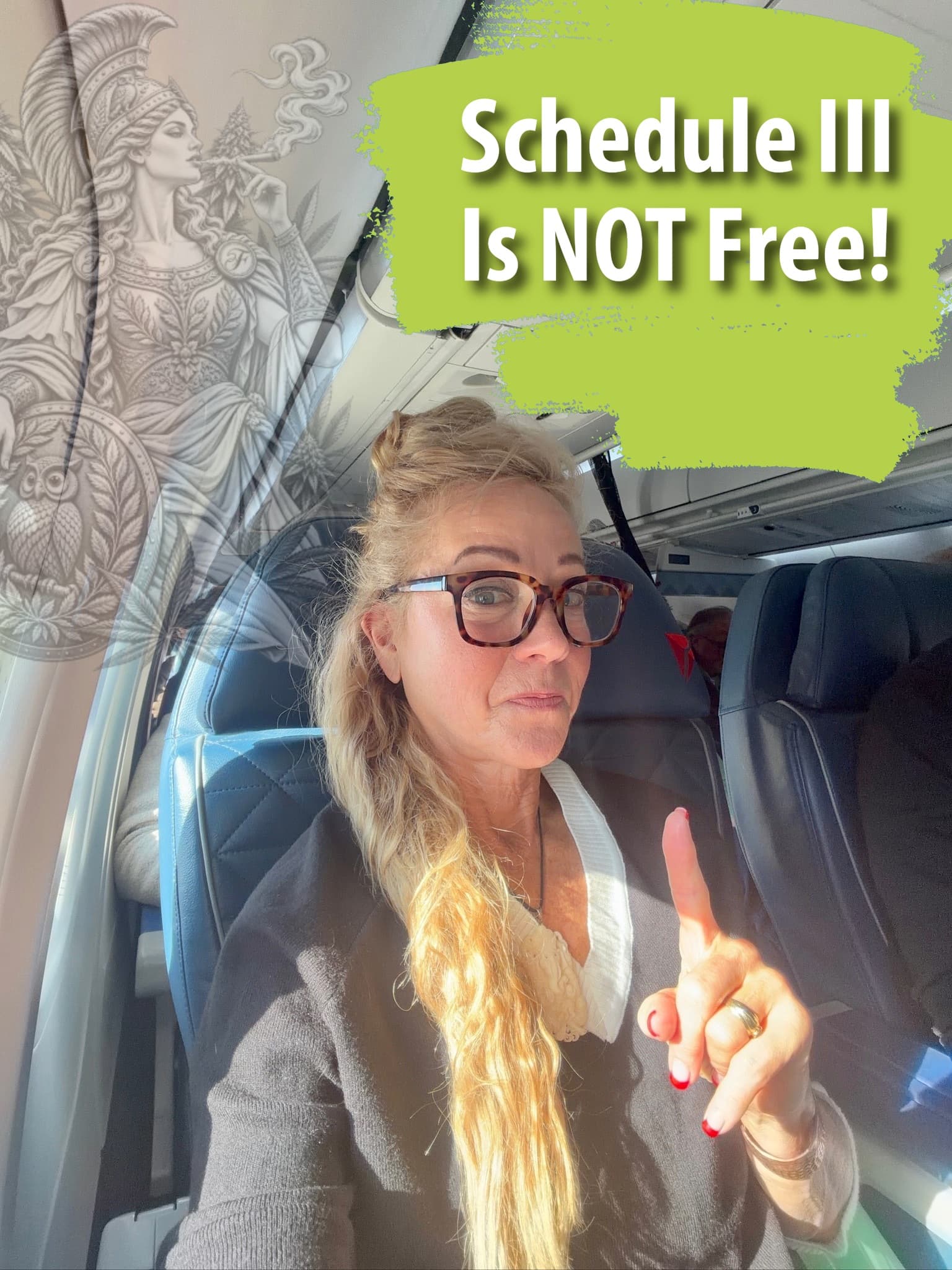
The Reform — Rescheduled. But Are We Free?
The Difference Between Cannabis Rescheduling and Descheduling
SCHEDULE 3 DOES NOT MEAN FREE.
You've seen the headlines. Federal officials have recognized medical uses for certain marijuana products, and Schedule III is being celebrated as progress.
But here's what the headlines don't always explain:
Schedule III is not federal legalization. It does not automatically release cannabis prisoners, erase convictions, or give farmers and small businesses unrestricted access to the plant.
And now, a proposed bill in Congress brings another possibility into the conversation: descheduling marijuana entirely.
So what's the difference? Who makes the rules? Who gets access? Who benefits?
Welcome to the next chapter of Beyond the Smoke: The Cannabis Power Play.
THE REFORM.
Because changing the classification of a plant is not necessarily the same as changing the system that controls it.
What Does Drug Scheduling Actually Mean?
Under the federal Controlled Substances Act (CSA), controlled drugs are classified into five schedules based on factors including accepted medical use, abuse potential, and dependence.
Here's the simple breakdown:
- Schedule I: Drugs classified as having no currently accepted medical use under federal scheduling criteria and a high potential for abuse. Examples include heroin and LSD.
- Schedule II: Drugs with accepted medical uses and a high potential for abuse, including oxycodone and fentanyl.
- Schedule III: Drugs with accepted medical uses and lower abuse potential than Schedules I and II, including ketamine and certain codeine-containing medications.
- Schedule IV: Drugs with lower abuse potential than Schedule III, including Xanax and Valium.
- Schedule V: Drugs with the lowest abuse potential of the five schedules, including certain preparations containing limited amounts of codeine.
Every schedule involves federal control.
That distinction matters because moving a substance to Schedule III does not mean it becomes legal for everyone to grow, manufacture, distribute, or purchase.
A lower schedule is still a schedule.
Cannabis Rescheduling vs. Descheduling: Two Words That Change Everything
Understanding the difference between cannabis rescheduling vs. descheduling is essential to understanding the future of the cannabis industry.
Rescheduling means moving a substance from one federal controlled-substance schedule to another.
Descheduling means removing a substance from the Controlled Substances Act's scheduling system entirely.
Descheduling does not mean eliminating all rules. Federal and state governments could still regulate cultivation, manufacturing, product safety, sales, and consumer access.
But it changes the foundation of federal cannabis policy.
Rescheduling changes how a substance is controlled.
Descheduling removes it from that particular system of control.
There is a difference between changing the rules and changing the system.
Schedule III Cannabis: What Actually Changed in 2026?
In April 2026, a federal rule moved specified FDA-approved marijuana-containing products and marijuana covered by qualifying state medical marijuana licenses into Schedule III.
That action did not reschedule all marijuana.
Other marijuana products remain subject to Schedule I restrictions, and broader federal rescheduling remains a separate regulatory process.
Read the April 2026 federal marijuana rescheduling rule.
This development matters for medical research and regulated medical access.
But it also raises important questions about who can participate in the marketplace.
Federal registrations, specialized facilities, product approvals, and complex compliance systems can require significant financial resources.
Could smaller farmers and independent businesses face greater barriers than well-funded corporations?
Schedule III does not automatically grant pharmaceutical companies exclusive control over cannabis. But medical recognition alone does not guarantee equal commercial opportunities.
Having spent more than a decade in the pharmaceutical industry and years working with cannabis, farming, and hemp advocacy, I've seen how regulatory systems can shape access and opportunity.
That's why we believe the conversation must go beyond the scheduling announcement.
Who makes the rules?
Who can afford to follow them?
Who gets access?
Who benefits?
That is the Cannabis Power Play.
Federal Cannabis Reform: A Proposal to Deschedule Marijuana
On October 29, 2026, Tennessee Congressman Steve Cohen introduced H.R. 10923 — the Public Health and Research Reforms in Controlled Substances Act of 2026.
The proposal calls for removing marijuana from the federal Controlled Substances Act's schedules rather than simply moving it to Schedule III.
It also addresses issues involving scientific research, controlled-substance policy, and sentencing.
H.R. 10923 is a legislative proposal, not an enacted change to federal law.
Read H.R. 10923 on Congress.gov.
The proposal brings an important distinction into focus:
Rescheduling cannabis preserves federal scheduling control. Descheduling removes marijuana from that system.
At Franny's Farmacy, we support rigorous scientific research, consumer safety, and responsible regulatory frameworks that allow states to shape their cannabis programs within applicable federal law.
We also believe meaningful federal cannabis reform must consider independent cultivation, small-business participation, consumer access, and the people whose lives have been affected by cannabis criminalization.
The conversation cannot begin and end with pharmaceutical access.
It must also consider farmers, independent manufacturers, small businesses, and communities that have spent decades working with this plant.
Medical progress matters. But medical progress and meaningful freedom are not necessarily the same thing.
Cannabis Criminal Justice Reform: What About the People Still Behind Bars?
There's another meaning of free that cannot be overlooked.
PEOPLE.
Rescheduling marijuana does not automatically release people incarcerated for cannabis offenses, expunge convictions, or erase the consequences of past enforcement.
Even descheduling would not, by itself, guarantee relief for every person with a prior cannabis conviction or sentence.
Those outcomes require additional legal action.
Franny's Farmacy supports cannabis criminal justice reform, including record-clearing measures, appropriate relief for people incarcerated for nonviolent cannabis offenses, and policies that address the lasting consequences of prohibition.
Organizations such as the Last Prisoner Project continue working on prisoner release, record clearance, cannabis-related criminal justice reform, and reentry support.
As new commercial opportunities emerge, we cannot lose sight of the people who continue to experience the consequences of cannabis criminalization.
How can we celebrate the expanding business opportunities surrounding cannabis without confronting the lasting human consequences of prohibition?
A change in federal classification is not automatically a change in someone's sentence.
That is a distinction that deserves just as much attention as the financial opportunities surrounding cannabis reform.
Federal Hemp Restrictions 2026: What About Hemp?
While marijuana rescheduling and descheduling make headlines, hemp faces a separate federal policy challenge.
Most of the revised federal hemp-definition provisions are scheduled to take effect on December 11, 2026, unless further federal action changes that timeline.
Certain restrictions involving cannabinoids that cannot be naturally produced by the cannabis plant already took effect on November 12, 2026.
Among the December changes is a provision that excludes finished hemp-derived cannabinoid products exceeding a combined threshold of 0.4 milligrams of total THC and specified similarly acting cannabinoids per container from the federal hemp definition.
Per container. Not per serving.
These federal hemp restrictions in 2026 could affect products currently sold as hemp, along with the farmers, manufacturers, retailers, employees, and consumers connected to them.
Read the Congressional Research Service analysis of the federal hemp definition changes.
Marijuana descheduling and hemp protection are separate legislative issues, but both raise fundamental questions about how the cannabis plant is regulated and who has access to it.
Same plant. Different rules.
At Franny's Farmacy, we believe consumer safety and responsible business access should not be treated as opposing goals.
Our proposed approach to responsible hemp regulation is built on four pillars:
- 21+ age restrictions
- Child-resistant packaging
- Certified third-party testing
- Certified manufacturing standards
These safeguards are designed to protect consumers, reduce youth access, and establish accountability throughout the hemp industry.
We support responsible regulation that takes public-safety concerns seriously while preserving opportunities for compliant businesses.
Learn more about federal hemp policy and Save NC Hemp.
Beyond the Smoke: Taking the Conversation to Washington
This is not just a conversation we're having online.
On November 17, 2026, Franny Tacy traveled to Washington, D.C., as part of a national hemp industry advocacy fly-in.
We brought the experiences and concerns of hemp businesses, farmers, and consumers directly to congressional offices.
Among those meetings was a conversation with Senator Ted Budd's staff.
They listened. They took notes. They acknowledged hearing from constituents and supporters nationwide who want regulation rather than prohibition.
But the meeting did not produce a commitment to change the Senator's public position.
What it did demonstrate was an opportunity for continued dialogue.
Concerns about protecting children, preventing underage access, and ensuring consumer safety are shared by Franny's Farmacy and responsible members of the hemp industry.
The disagreement is not about whether consumers need protection. It is about how we protect them.
Our four pillars of responsible hemp regulation represent a proposed approach to those shared concerns.
Our broader cannabis policy priorities include:
- Meaningful federal marijuana reform.
- Rigorous, independent cannabis research.
- Responsible state regulatory programs.
- Opportunities for independent farmers and small businesses.
- Addressing cannabis-related convictions and incarceration.
- Preserving a workable legal framework for hemp.
These are the policy priorities Franny's Farmacy advocates for, not outcomes that a single legislative proposal would necessarily accomplish.
Because meaningful reform involves more than changing the classification of a plant.
It involves examining the systems that determine access, opportunity, accountability, and freedom.
The Cannabis Power Play: Reform for Whom?
We support scientific research.
We support consumer safety.
We support responsible regulation.
We support fair opportunities for businesses of all sizes.
And we believe descheduling deserves a serious place in the national conversation alongside criminal justice reform.
Because cannabis reform should be about more than a new classification or new commercial opportunities for the most powerful companies.
If large corporations gain access while independent businesses struggle and people remain incarcerated, how much of prohibition have we really addressed?
SCHEDULE 3 DOES NOT MEAN FREE.
Medical recognition is one measure of progress.
But meaningful reform must also confront questions of access, accountability, economic opportunity, and criminal justice.
WHO MAKES THE RULES?
WHO GETS ACCESS?
WHO BENEFITS?
These are the questions at the heart of Beyond the Smoke: The Cannabis Power Play.
SHOW US THE EVIDENCE.
SHOW US THE MONEY.
SHOW US WHO BENEFITS.
And if we're calling it reform, show us who is actually being freed.
FREE THE PLANT. FREE THE PEOPLE.
Take Action Center: Get Informed. Make Your Voice Heard.
THE FUTURE OF HEMP IS AT STAKE. THE CLOCK IS TICKING.
DECEMBER 11, 2026 — THE FEDERAL HEMP DEADLINE IS APPROACHING.
Explore the Save NC Hemp action center to learn about federal hemp legislation, the proposed regulatory alternatives, and opportunities to participate in the public discussion.
SIGN THE PETITION — SAVE NC HEMP
SHARE YOUR OPINION WITH SENATOR TED BUDD
Read the Legislation. Understand the Issues.
H.R. 10923 — Public Health and Research Reforms in Controlled Substances Act of 2026
April 2026 Federal Marijuana Rescheduling Rule
Congressional Research Service — Changes to the Statutory Definition of Hemp
Last Prisoner Project — Cannabis Criminal Justice Reform
WE SUPPORT RESPONSIBLE REGULATION. WE OPPOSE DESTRUCTION DISGUISED AS REGULATION.
GET THE FACTS. SEE WHAT'S AT STAKE. MAKE YOUR VOICE HEARD.
Franny's Farmacy | Beyond the Smoke: The Cannabis Power Play | The Reform | Hemp Education & Advocacy
Editorial Note: Beyond the Smoke: The Cannabis Power Play is an educational and advocacy series presented by Franny's Farmacy, reflecting founder and CEO Franny Tacy's professional experience and perspective on cannabis, hemp, federal policy, responsible regulation, and criminal justice reform. References to legislation, federal scheduling, and regulatory deadlines reflect information available at the time of publication and may change. Proposed legislation is not enacted law. Descriptions of private congressional meetings reflect Tacy's firsthand account and have not been independently verified. The four pillars of hemp regulation represent Franny's Farmacy's proposed consumer-protection framework, not enacted federal requirements. This content is educational and advocacy commentary, not legal, financial, or medical advice.
The Future of Hemp Needs Your Voice.
Stay informed, understand what's at stake, and help protect the future of hemp in North Carolina.
Take Action — Save NC Hemp