10/28/2026
Smoke & Mirrors Episode 6: What is THCa?
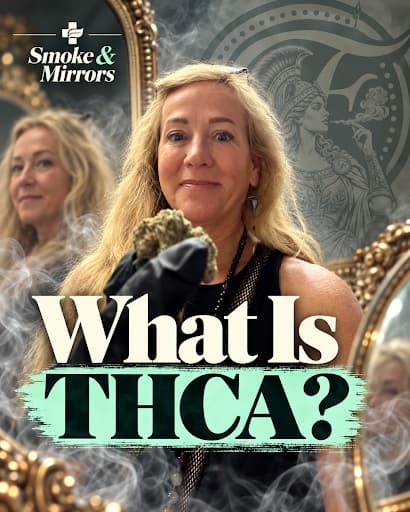
Sense or Nonsense: THCA Is the Same as THC
Nonsense. But there's more to the science than a simple yes or no.
You've probably heard people use THCA and THC interchangeably.
You've also heard that cannabis is a complicated plant, that heating it changes its chemistry, and that lawmakers are reconsidering how hemp products should be defined and regulated.
So where does the science end and the confusion begin?
That's the smoke: Treating two related cannabinoids as though they're chemically identical—or assuming their differences tell us everything we need to know about a product.
The mirror: Looking at what these compounds actually are, how they change, and why those differences matter.
Welcome back to Smoke & Mirrors.
Before we debate how cannabis should be regulated, let's understand a little more about the plant itself.
Start With the Whole Plant
Cannabis is a remarkable plant.
Researchers have identified more than 100 phytocannabinoids—naturally occurring compounds produced by cannabis.
Some familiar names include CBD, CBG, CBN, THCV, delta-9 THC and THCA.
But here's what Franny finds especially fascinating:
Our bodies already have a system that can interact with cannabinoids.
It's called the endocannabinoid system, and it's found throughout the human body and in other mammals.
This system helps regulate important functions, including mood, appetite, sleep and pain signaling.
Even more remarkable? Our bodies naturally produce their own cannabinoids, called endocannabinoids.
These molecules interact with receptors in the body, and certain cannabinoids from the cannabis plant can interact with parts of that same signaling system.
Think about that for a moment.
Our bodies already have the biological machinery that makes these interactions possible.
Without those receptors and signaling pathways, cannabinoids wouldn't interact with our bodies in the same ways.
For Franny, that connection is more than interesting chemistry.
After decades of working with plants, farming, pharmaceuticals and hemp, she sees something deeply meaningful in the relationship between cannabis and the human body.
Franny believes this connection is no accident—that there's something extraordinary, even spiritual, about a plant producing compounds that can interact with a system our bodies already possess.
Science can explain the receptors, the molecules and some of their interactions. It cannot establish whether that connection exists by design or coincidence.
Still, the connection raises questions worth exploring.
Why do different cannabinoids interact with the body differently?
What might further research reveal about their potential benefits and risks?
And how much more could we learn if we approached this plant with curiosity rather than assumptions?
Here's the mirror: The endocannabinoid system is real. Our bodies produce their own endocannabinoids. And certain compounds from cannabis can interact with that system.
What that connection means—scientifically, personally and even spiritually—is a conversation worth having.
Before we regulate the plant, shouldn't we understand the relationship between the plant and the people who use it?
The Mirror: So, What Exactly Is THCA?
THCA stands for tetrahydrocannabinolic acid.
It's a naturally occurring cannabinoid found in cannabis, particularly in fresh or unheated plant material.
THCA is a chemical precursor to delta-9 THC.
That means THCA can be converted into delta-9 THC through a chemical process called decarboxylation.
THCA itself is generally considered non-intoxicating in its unheated form.
Delta-9 THC, by contrast, is known for its intoxicating effects.
Same plant. Related compounds. Different chemical structures and properties.
That's the distinction at the center of this episode.
And it's one worth understanding before drawing conclusions about how a cannabis product may affect someone.
What Happens When You Apply Heat?
Here's where the chemistry changes.
When THCA is exposed to sufficient heat, it can lose a carbon dioxide group and convert into delta-9 THC.
That process is called decarboxylation.
It can occur when cannabis is smoked, vaped or heated during cooking.
The amount converted depends on factors such as temperature, heating time and the material involved. Conversion may be incomplete, and some THC can degrade under certain conditions.
Decarboxylation can also occur gradually during storage or processing, so heat isn't the only factor that can influence a product's cannabinoid profile over time.
The smoke: "THCA and THC are the same thing," or "THCA can never become intoxicating."
The mirror: THCA and delta-9 THC are chemically distinct, but THCA can convert into delta-9 THC.
That means the chemistry of the starting material doesn't necessarily tell us everything about the product as it's ultimately consumed.
And that's why careful testing and accurate labeling matter.
Different Plants. Different Cannabinoid Profiles.
Franny's Farmacy approaches cannabis with decades of experience in farming, pharmaceuticals, hemp business operations and advocacy.
That experience offers a practical perspective on something familiar to anyone who grows crops:
Genetics and growing conditions matter.
Think about tomatoes.
Different varieties can produce different sizes, colors, flavors and characteristics.
Cannabis varieties can likewise produce different concentrations and combinations of cannabinoids.
Growing conditions, harvest timing, processing and storage can also influence the plant's final chemical profile.
Some varieties contain higher concentrations of THCA. Others are cultivated for different cannabinoid profiles.
But the analogy has limits.
A plant's cannabinoid content must be established through appropriate testing—not assumed from its name, appearance or growing history.
Here's the smoke: Treating all cannabis varieties as though they contain the same compounds in the same amounts.
Here's the mirror: Cannabis chemistry varies, and understanding that variation requires both agricultural knowledge and reliable laboratory analysis.
That's agriculture informed by science.
Why Does THCA Matter in the Hemp Debate?
Because chemistry and legal definitions aren't always the same thing.
The 2018 Farm Bill established a federal hemp definition based on no more than 0.3% delta-9 THC on a dry-weight basis.
Federal hemp cultivation-testing requirements, however, account for THCA's potential conversion into delta-9 THC.
Those are different parts of the regulatory framework.
A new federal hemp definition is scheduled to take effect on December 11, 2026.
Among its provisions, the enacted law introduces a 0.4-milligram combined total-per-container threshold for certain finished hemp-derived cannabinoid products, addressing total tetrahydrocannabinols, including THCA, and certain other cannabinoids with similar effects.
Per covered finished container. Not per serving.
That distinction could affect products containing THCA or other cannabinoids covered by the revised definition.
But it doesn't mean every hemp product automatically becomes unlawful.
The impact depends on the product, its composition and the applicable legal requirements.
The smoke is assuming that a chemical distinction automatically settles a legal question.
The mirror is recognizing that science helps explain the compounds, while statutes and regulations determine how products are classified.
Both deserve careful attention.
A Brief Look Ahead: More Than One Regulatory Timeline
December 11 is the scheduled federal deadline, but North Carolina businesses may also need to follow developments closer to home.
The state's proposed HB 328 could establish additional requirements and a separate compliance timeline if enacted.
HB 328 is not currently law, and a change to federal requirements would not necessarily change future state obligations.
We'll examine those separate legal processes more closely in another Smoke & Mirrors installment.
For now, the focus is the science—and why understanding THCA matters when evaluating policy claims.
Beyond the Headlines: Why Firsthand Experience Matters
Franny Tacy's decades of experience with cannabis, farming, pharmaceuticals and hemp advocacy offer Franny's Farmacy a valuable perspective on how plant science connects with cultivation, manufacturing and consumer education.
That experience helps us recognize practical questions about plant genetics, testing, processing and product consistency.
But firsthand experience is not a substitute for scientific research or laboratory evidence.
We believe the strongest conversation makes room for all three:
What the research shows.
What experienced growers and businesses observe.
And what policymakers are proposing.
Each provides a different kind of information.
Understanding where they overlap—and where questions remain—is part of what Smoke & Mirrors is here to explore.
The Final Mirror: THCA Is Not Delta-9 THC
Let's return to the original question.
Sense or Nonsense: THCA is the same as delta-9 THC?
Nonsense.
THCA and delta-9 THC are chemically distinct compounds.
THCA is generally non-intoxicating in its unheated form.
Under suitable conditions, THCA can convert into delta-9 THC through decarboxylation.
And that conversion matters when evaluating cannabis chemistry, product testing and legal requirements.
But the conversation shouldn't stop there.
How should products be tested?
What information should labels provide?
How should regulations account for compounds that can change during heating or processing?
And how can policymakers protect consumers while making rules that reflect the science?
At Franny's Farmacy, we believe responsible regulation begins with understanding what is actually being regulated.
The smoke is the oversimplification.
The mirror is the chemistry.
And the truth becomes clearer when we're willing to look beyond both the headlines and our assumptions.
Before we regulate the plant, shouldn't we understand the plant?
Sense or Nonsense? Keep asking. Keep learning. Follow the facts.
Sources and Resources
Scientific and regulatory information
- FDA — Cannabis and cannabis-derived products, including CBD
- USDA — Hemp regulations and testing requirements
- Federal Public Law 119-37 — hemp-definition changes
- North Carolina HB 328 — official legislative history
Industry research and additional perspectives
- Whitney Economics — hemp and cannabis economic research
- NC Hemp Facts — North Carolina economic-impact information
- North Carolina Responsible Business Association
- Ganjapreneur — cannabis policy reporting
- North Carolina State Cannabis — independent cannabis information portal
- North Carolina Advisory Council on Cannabis — submit public comments
Follow & Stay Connected
📱 Follow Franny's Farmacy on Instagram: @frannysfarmacy
🌿 Protect North Carolina Hemp — Take Action: SAVE NC HEMP
Franny's Farmacy's Position
🌿 THE FUTURE OF HEMP IS AT STAKE. THE CLOCK IS TICKING.
⏳ DECEMBER 11, 2026 — THE FEDERAL HEMP DEADLINE IS APPROACHING.
The December 11 federal hemp restrictions put North Carolina's $3.2 billion hemp industry, approximately 16,000 jobs, thousands of small businesses, farmers, and consumer access at risk.
Explore the legislation. Understand the consequences. Find your lawmakers, access ready-to-use contact scripts, and explore the Save NC Hemp petition.
👉 GET INFORMED & TAKE ACTION — SAVE NC HEMP
For additional North Carolina industry information, explore the NCRBA.
We Support Responsible Regulation. We Oppose Destruction Disguised as Regulation.
GET THE FACTS. SEE WHAT'S AT STAKE. MAKE YOUR VOICE HEARD.
THE COUNTDOWN IS ON. YOUR VOICE MATTERS.
“Don't believe everything you hear through the haze.
There's a difference between what sounds convincing and what's actually true.
Franny's is following the facts, asking the hard questions, and clearing up the confusion.
Don't let the conversation end here.”
Franny's Farmacy | Smoke & Mirrors | Hemp Education & Advocacy
The Future of Hemp Needs Your Voice.
Stay informed, understand what's at stake, and help protect the future of hemp in North Carolina.
Take Action — Save NC Hemp