10/23/2026
The 0.4mg Cap
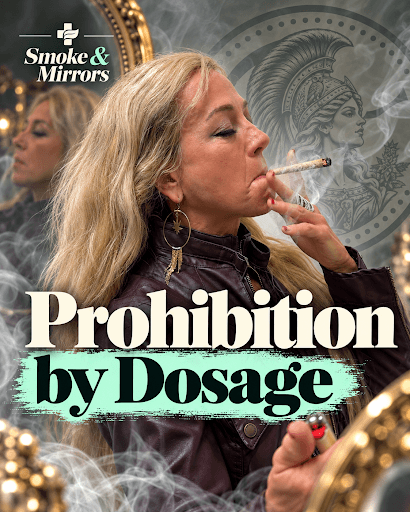
Sense or Nonsense: The 0.4mg Cap Is Just Another Safety Regulation
Nonsense. Not when the number could make entire categories of currently legal hemp products impossible to sell.
They call it a safety measure.
They call it closing a loophole.
But what happens when a regulation sets a limit so low that responsible businesses can no longer offer products consumers already purchase legally?
What happens when the rules focus on a number without adequately considering the complexity of the plant, the type of product, or the protections already available through testing and labeling?
And who can afford to remain in the marketplace when compliance becomes more complicated and product options disappear?
Welcome back to Smoke & Mirrors.
Today, we're looking at a very small number with potentially enormous consequences.
0.4 milligrams.
The Mirror: What Does the 0.4mg Cap Actually Mean?
Federal legislation enacted in 2025 changes the definition of hemp beginning December 11, 2026.
For covered finished hemp-derived cannabinoid products, the revised definition establishes a threshold of 0.4 milligrams of combined total tetrahydrocannabinols and certain other cannabinoids with similar effects per container.
Not per serving.
Not per gummy.
Per finished container.
Consider a gummy containing 5 milligrams of THC.
5 mg ÷ 0.4 mg = 12.5
That single gummy contains 12.5 times the new threshold.
And that's before placing multiple gummies in a package.
A product exceeding the threshold may no longer qualify as hemp under the revised federal definition. Its legal status would depend on other applicable laws; exceeding the threshold does not automatically mean every sale is a federal criminal offense.
But the practical concern remains.
How do responsible businesses continue offering familiar hemp-derived products when the definition itself excludes them?
That's why Franny calls this approach prohibition by dosage.
The Science: Cannabis Is More Than One Molecule
Cannabis is a complex plant.
It produces cannabinoids such as CBD, THC, CBG, and CBN, along with aromatic compounds called terpenes.
Scientists are studying how these compounds interact and whether combinations of cannabinoids and terpenes influence their effects.
This is often discussed as the entourage effect.
The theory is that compounds found together in cannabis may interact in ways that differ from their effects in isolation.
Cannabis cannot be fully understood by reducing it to one compound or one number.
Different varieties contain different cannabinoid profiles.
Different products contain different concentrations and combinations.
And different routes of administration can create different exposure patterns.
These distinctions are relevant when deciding how products should be tested, labeled, manufactured, and regulated.
Understanding the plant should come before deciding which products can remain on the shelf.
The Bigger Question: Who Gets to Control the Market?
There's another part of this conversation we believe deserves attention.
You cannot obtain a patent simply by claiming ownership of a naturally occurring plant as it exists in nature.
But certain isolated compounds, synthetic formulations, manufacturing processes, and specific pharmaceutical inventions may qualify for patent protection.
That distinction has long influenced how plants and plant-derived compounds are developed into commercial medicines.
And it raises questions about hemp's future.
What happens when restrictions make broad categories of hemp-derived products commercially impractical?
Which businesses can afford to adapt?
Which companies have the resources to pursue expensive regulatory pathways?
And what happens to smaller farmers, manufacturers, and retailers that helped establish the legal hemp industry?
We should not assume every restriction is designed to benefit a particular competitor.
But we absolutely should examine who benefits from a regulatory framework—and who may be excluded by its costs and requirements.
Because a product can be restricted without every cannabis-derived compound disappearing from the market.
And a plant can remain lawful for some purposes while many existing consumer products become impossible to offer legally.
That's a distinction worth understanding before calling the result consumer protection.
When the Math Threatens the Marketplace
The 0.4mg cap is not simply a packaging challenge.
Putting fewer gummies in a container does not solve the problem if even one gummy exceeds the threshold.
For some products, reformulation may be possible.
For others, the change could eliminate a commercially viable product category.
And the impact may extend beyond products intended to produce intoxicating effects.
Some full-spectrum CBD products contain naturally occurring trace amounts of THC.
Depending on the concentration and total contents of the package, certain CBD oils, topicals, pet products, and other hemp-derived products could also be affected or become illegal.
That does not mean every CBD product or every topical becomes illegal.
It means businesses must evaluate whether their finished products meet the revised definition—and whether reformulation is scientifically, commercially, and practically feasible.
For smaller businesses, those decisions can carry significant costs.
New formulations.
Additional testing.
Packaging changes.
Inventory losses.
Uncertainty about what can be manufactured or sold.
Meanwhile, larger companies may have more capital and regulatory resources to adapt.
Same rule. Very different ability to survive it.
That is why Franny's Farmacy continues to ask:
Is this creating a safer hemp marketplace—or making it harder for responsible businesses to participate in one?
Responsible Regulation Should Protect Consumers, Not Eliminate Their Choices
Let's be clear.
Franny's Farmacy supports responsible regulation.
We believe hemp products should be manufactured responsibly, tested appropriately, labeled accurately, and sold with meaningful consumer safeguards.
We support appropriate age restrictions and enforcement against businesses that violate the rules.
We recognize that potency, accidental exposure, misleading claims, and inconsistent product quality are legitimate concerns.
Those issues deserve serious attention.
But we believe effective regulation should address those risks directly.
Testing tells consumers what's in a product.
Accurate labeling helps consumers understand what they're purchasing.
Manufacturing standards help establish consistent quality.
Age restrictions and enforcement help protect minors.
Those are meaningful tools.
And they raise an important question:
Why should a single per-container threshold be the primary measure of whether a product can remain in the hemp marketplace?
Shouldn't policy also consider serving size, product type, intended use, testing, labeling, and actual consumer-safety risks?
We believe safety and responsible access can—and should—exist together.
The Final Mirror: When Regulation Becomes Prohibition by Dosage
The smoke: It's only a 0.4mg limit. Hemp remains legal.
The mirror: For many existing hemp-derived products, that small number could determine whether they qualify as hemp at all.
And when a regulation removes products from the legal marketplace, the consequences extend beyond a label.
They reach farmers.
Manufacturers.
Small-business owners.
Employees.
And consumers who have come to rely on responsible, transparent businesses.
We are not arguing for an industry without standards.
We are arguing for standards that make sense.
Standards that protect people without unnecessarily eliminating products.
Standards that hold irresponsible operators accountable without pricing responsible businesses out of existence.
And standards that consider what happens when consumers lose access to products they currently purchase legally.
Because when demand persists but lawful access contracts, some consumers may seek alternatives outside the regulated marketplace.
That's a risk responsible policymakers should consider—not ignore.
At Franny's Farmacy, we believe the future should be built on science, transparency, accountability, and fair opportunity.
Not prohibition disguised as protection.
0.4 milligrams may sound like a small number.
But its consequences could be anything but small.
Sense or Nonsense? You decide.
Watch, Follow & Stay Connected
🎥 Watch Episode Three on YouTube: Smoke & Mirrors: The 0.4mg Cap
📱 Follow Franny's Farmacy on Instagram: @frannysfarmacy
🌿 Take Action: Save NC Hemp
Franny's Farmacy's Position
🌿 THE FUTURE OF HEMP IS AT STAKE. THE CLOCK IS TICKING.
⏳ DECEMBER 11, 2026 — THE FEDERAL HEMP DEADLINE IS APPROACHING.
The December 11 federal hemp restrictions put North Carolina's estimated $3.2 billion hemp industry, approximately 16,000 supported jobs, thousands of small businesses, farmers, and consumer access at risk.
Explore the legislation. Understand the consequences. Find your lawmakers, access ready-to-use contact scripts, and explore the Save NC Hemp petition.
👉 GET INFORMED & TAKE ACTION — SAVE NC HEMP
For additional North Carolina industry information, explore the NCRBA.
We Support Responsible Regulation. We Oppose Destruction Disguised as Regulation.
GET THE FACTS. SEE WHAT'S AT STAKE. MAKE YOUR VOICE HEARD.
THE COUNTDOWN IS ON. YOUR VOICE MATTERS.
“Don't believe everything you hear through the haze.
There's a difference between what sounds convincing and what's actually true.
Franny's is following the facts, asking the hard questions, and clearing up the confusion.
Franny's Farmacy | Smoke & Mirrors | Hemp Education & Advocacy
The Future of Hemp Needs Your Voice.
Stay informed, understand what's at stake, and help protect the future of hemp in North Carolina.
Take Action — Save NC Hemp