10/02/2026
The Federal Hemp Law Is Changing: What It Could Mean for Franny’s Farmacy
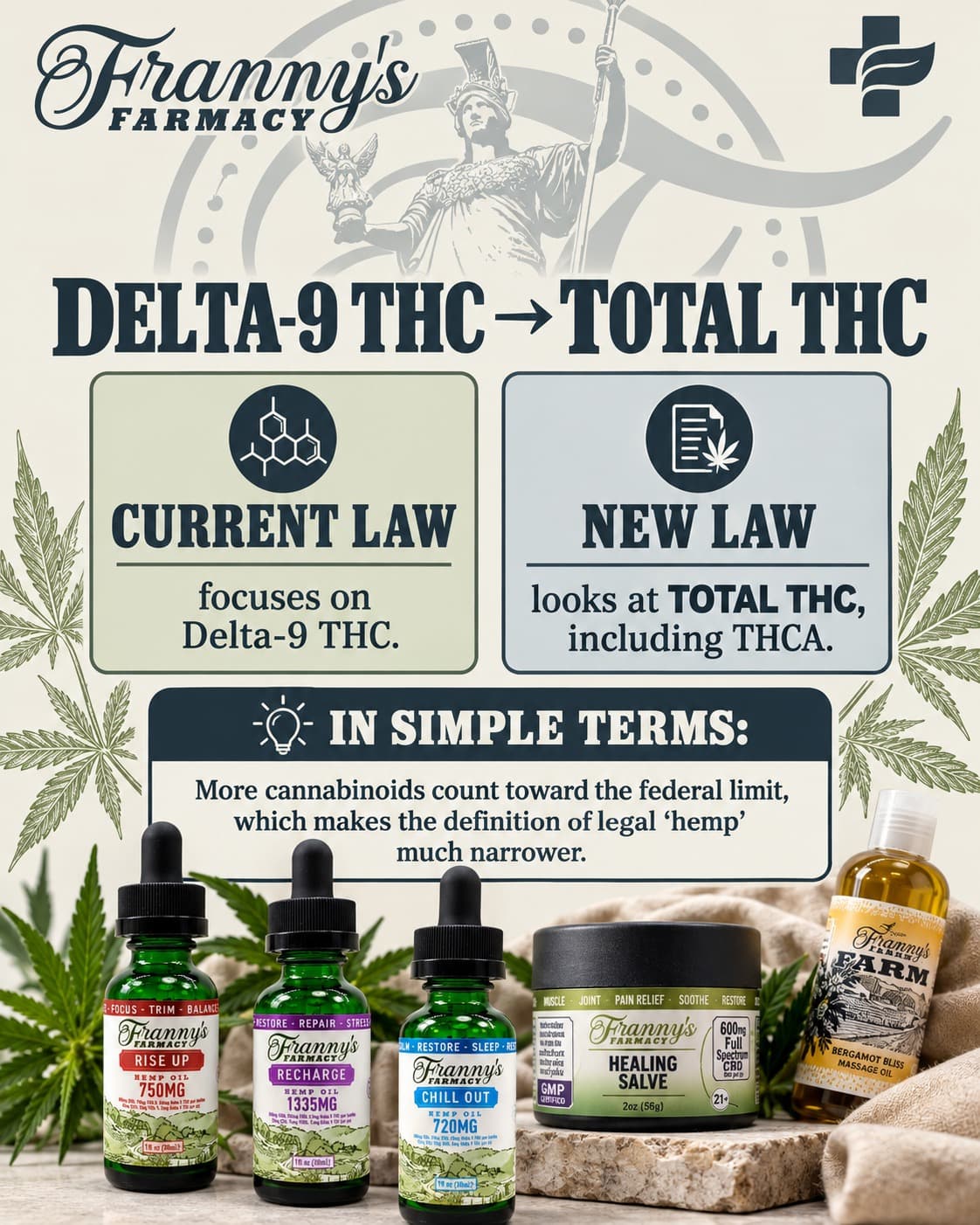
For nearly a decade, the federal definition of hemp has shaped how hemp products are grown, manufactured, tested, and sold across the United States. Now, that definition is changing again—and the impact could reach far beyond products commonly associated with Delta-9 THC.
A federal law passed in 2025 created a much narrower definition of legal hemp. In September 2026, Congress passed and the President signed a short-term funding measure that delayed most of those changes until December 11, 2026. Some provisions are still scheduled to begin applying on November 12, so the transition is more complicated than simply moving one deadline. Klobuchar Senate
For hemp businesses like Franny’s Farmacy, the biggest question is what the new definition could mean for products that have been legally produced and sold under the framework created by the 2018 Farm Bill.
What is changing?
Under the 2018 Farm Bill framework, hemp is generally distinguished from marijuana using a 0.3% Delta-9 THC limit on a dry-weight basis. The new federal language changes that framework by looking more broadly at total THC, including THCA, rather than Delta-9 THC alone. US Codex
The law also creates new rules specifically for finished hemp-derived cannabinoid products.
One of the most significant provisions is a limit of 0.4 milligrams combined total per container of total THC and certain other cannabinoids with similar effects. Importantly, that is a per-container limit—not a per-serving limit. US Codex
That distinction matters.
A package containing multiple gummies, for example, would be evaluated based on the combined amount in the entire container under this provision—not simply the amount contained in one gummy.
Putting 0.4 milligrams into perspective
Many hemp-derived products currently available contain cannabinoid amounts measured in several milligrams per serving.
That means a 0.4 mg per-container threshold is substantially lower than the THC content of many products currently sold under the existing federal framework.
As a result, the new definition could affect a wide range of finished hemp-derived cannabinoid products—not just one particular product category. Congressional Research Service analysis has similarly noted that the changes are expected to alter the legal status of many hemp products currently on the market. Congress.gov
Exactly how individual products will be affected will depend on their formulation, cannabinoid profile, packaging, applicable state law, and further federal guidance.
When does this happen?
The original changes enacted in 2025 were scheduled to take effect on November 12, 2026.
A new federal law signed September 2, 2026 temporarily narrowed which portions of those changes apply before December 11, 2026. Most notably for finished hemp-derived products, the 0.4 mg-per-container provision is effectively postponed until December 11. Certain exclusions involving cannabinoids that cannot naturally be produced by the cannabis plant are still scheduled to begin applying November 12. Planntz
So, as of September 29, 2026, the federal landscape is still evolving.
Congress could pass additional legislation before December 11, and federal agencies may issue additional guidance affecting how the law is interpreted or implemented.
State laws also remain separate and may impose requirements that are different from—or stricter than—federal law.
What does this mean for Franny’s Farmacy?
Franny’s Farmacy has operated in the hemp industry since its earliest days in North Carolina, and our approach has always centered on manufacturing standards, testing, transparency, education, and responsible access.
The upcoming federal changes could affect products throughout the hemp-derived cannabinoid marketplace, including products made by Franny’s and many other compliant hemp businesses.
Our position is that hemp policy should protect consumers while providing a workable regulatory framework for responsible businesses. That includes priorities we have consistently emphasized: 21+ access where appropriate, independent laboratory testing, transparent labeling, child-resistant packaging, responsible manufacturing, and consumer education.
Those are policy principles Franny’s Farmacy supports; they are separate from the specific requirements Congress ultimately chooses to enact.
What can consumers do?
The most important thing right now is to stay informed as the December deadline approaches. Consumers can review updates from Congress and federal and state regulators, learn how products are tested and labeled, and independently contact elected representatives if they want to share their own views about hemp policy.
Because this situation is still developing, be cautious with headlines that describe the federal changes as completely settled. The September legislation provided additional time, but it did not permanently resolve the broader debate over hemp-derived cannabinoid regulation. Foley Hoag
This isn’t over yet.
The hemp industry has changed dramatically since the 2018 Farm Bill, and policymakers are now deciding what the next federal framework will look like.
For Franny’s Farmacy, the conversation continues to come back to the same idea: consumer safety, clear standards, responsible manufacturing, and continued hemp access do not have to be mutually exclusive.
We’ll continue following federal and North Carolina developments and sharing verified updates as they happen.
Save this post, share accurate information, and follow the Franny’s Farmacy blog for future hemp policy updates.
This article is for general informational purposes and is not legal advice. Federal and state hemp laws are evolving, and requirements may change.